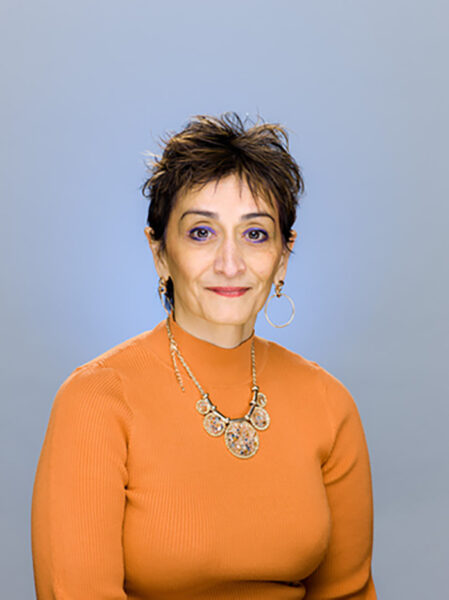
Dr. Mandana Vahabi is a Full Professor and Women’s Health Research Chair at the Lawrence Bloomberg Faculty of Nursing, University of Toronto, and Unity Health, an ICES Scientist, a Fellow of the Canadian Academy of Nursing, and an Adjunct Professor at Toronto Metropolitan University. She received the 2023 Canadian Cancer Society Award for Excellence in Cancer Research Inclusive Excellence Award and the 2024 Canadian Cancer Research Alliance Distinguished Service in Cancer Research Award.
Her research is centered on promoting equitable access to primary health care, with a strong focus on addressing cancer screening disparities among structurally marginalized populations. Dr. Vahabi collaborates both locally and globally with community stakeholders, leading large, cross-sectoral, and multidisciplinary teams to develop and implement innovative interventions aimed at advancing health equity through socially engaged research and knowledge mobilization.
Driven by the principles of social justice, inclusion, community engagement, and capacity building, she works closely with equity-deserving communities on systems-level projects. These initiatives, conducted in partnership with various levels of government, aim to develop evidence-based, inclusive health promotion programs and policies that improve health outcomes for vulnerable populations. Dr. Vahabi employs a broad range of research methods, including mixed methods and participatory action research.
2006 – Doctor of Philosophy, Nursing Science, University of Toronto
1992 – Master of Health Science, Community Health & Epidemiology, University of Toronto
1990 – Bachelor of Science in Nursing, University of Toronto
Dr. Vahabi’s PubMed link is available here
Dr. Vahabi’s Google Scholar profile
Yonas Abeb
Project Title: Improving cervical cancer screening access for underserved women in Ethiopia: A community-based participatory research approach using HPV self-sampling